

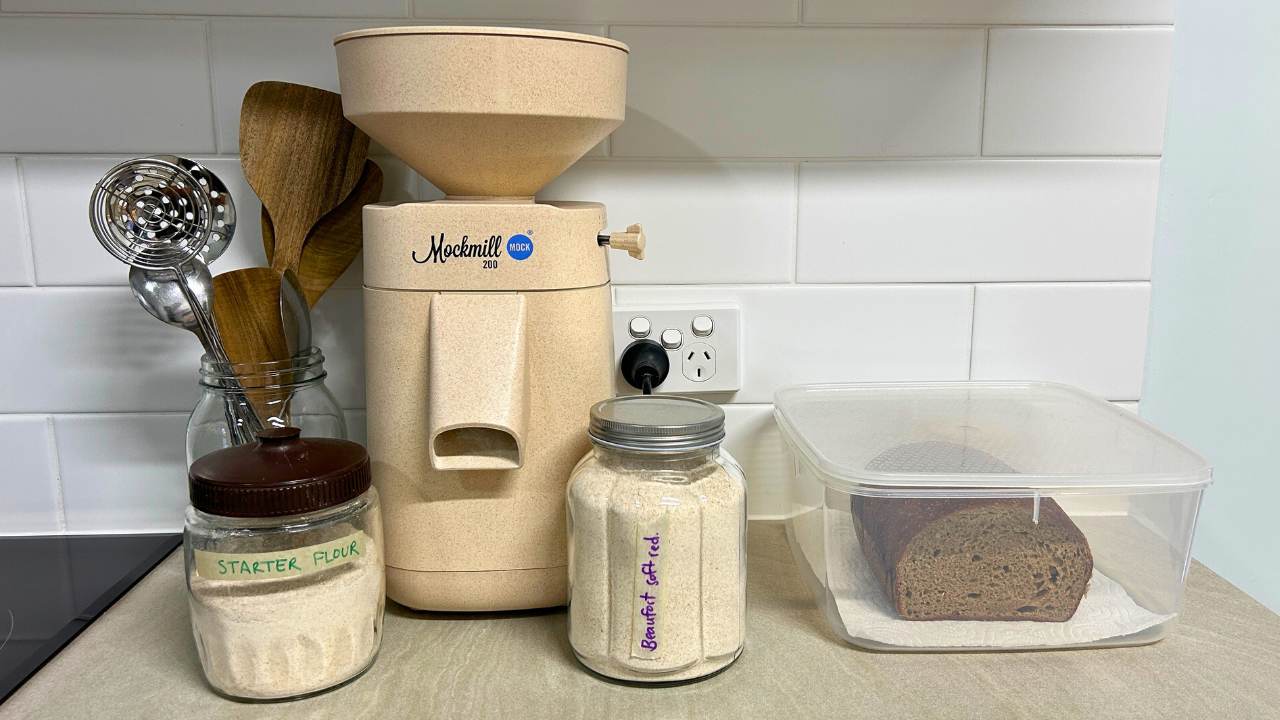
If you have just purchased a benchtop grain mill or are thinking about bringing one into your kitchen, the first questions that usually pop up are: How am I actually going to use this day to day? Is it going to be worth the counter space? How do I make this work without turning every bake into a massive production?
There is a school of thought in the home milling world that says: if you aren’t milling 100% of your flour fresh on demand right before you mix, you are defeating the whole purpose of owning a mill.
Ideally, milling fresh every single time is the gold standard. When you crack open a whole grain, all the vital germ and nutrient-dense oils are suddenly exposed to oxygen. Much like slicing into a fresh apple, oxidisation begins immediately, and whole grain flour will eventually degrade and spoil over time.
In an ideal world, we would do everything the ideal way. But real life doesn’t always allow for that, and I think that’s okay!
As I’ve gotten into my 50s, I’ve realised that creating flow and ease in life is about giving yourself permission to take sensible shortcuts. Having a grain mill doesn't mean you have to be dogmatic about it. Pre-milling a couple of small jars has completely eliminated friction in my kitchen, and here is how and why it works.
The Two Things That Stop Me From Milling Fresh
I am an organised person, but when it comes to sweet treats - cakes, slices, and biscuits - I am entirely spontaneous. I rarely plan those bakes out in advance. Two real-world factors usually stop me from pulling out whole grains in the moment:
The Morning Noise Factor:
Inspiration often strikes early on a Saturday or Sunday morning when I have a friend or my mum popping over for mid-morning coffee. My husband is usually still asleep. Whether you use a stone mill like my Mockmill 200 or an impact mill, grain mills are loud. If milling is the only way to get a cup of flour, I simply won't bake because I don't want to wake up the house.
Mental Bandwidth & Friction:
Sometimes you just don't have the energetic bandwidth to add an extra task to your morning. If having a jar of pre-milled flour sitting ready means I actually bake that little cake, that's a win. If having to set up the mill means I abandon the idea entirely, the "ideal" method just prevented me from enjoying making something nice in my kitchen.
The Bread Exception
Does this mean I pre-mill everything? Not at all.
I rarely pre-mill flour for my bread. I bake whole grain sourdough a couple of times each week, and I nearly always mill that flour right before mixing the dough, straight into the mixing bowl.
Because bread is a more regular process that I do more often, and it requires a larger volume of flour for each bake, milling on demand fits right into the rhythm. Pre-milling is reserved for low-stress convenience.
The Two Jars I Keep on Hand
I keep two specific jars of pre-milled flour in my kitchen, each treated a little differently depending on where it lives:
1. The Cake Flour Jar (Stored in the Fridge)
The Grain: currently it’s Beaufort organic soft red wheat (from Sovereign Foods).
The Quantity: About 600g to 700g.
Where It Lives: In a glass jar in the fridge.
Soft red wheat produces a gorgeous, tender crumb that is perfect for simple everyday cakes and slices. Freshly milled Beaufort soft red wheat is not something you can buy off a shelf in Australia; you can only access it by buying the whole grain and milling it yourself.
Keeping a jar of this in the fridge slows down oxidisation dramatically, preserves the natural oils, and keeps it beautifully fresh for weeks. When I want just one single cup of flour for a quick cake, it is sitting there waiting for me.
2. The Sourdough Starter Flour (Stored in the Cupboard)
The Grain: Hard White Wheat (a reliable, neutral strong flour base that suits nearly any loaf - currently Calibre variety, also from Sovereign Foods).
The Quantity: About 500g in a smaller jar.
Where It Lives: In my grain cupboard at room temperature.
I keep things simple: I don't maintain multiple starters. I keep one healthy sourdough starter and feed it from this small jar.
I live in the subtropics, where warmth and humidity can degrade whole grain flour faster at room temperature. But because 500g only lasts a few weeks in my kitchen, it doesn't sit around long enough to spoil. Most starters around the world are fed with heavily refined, months-old white flour from a supermarket shelf. Feeding your starter whole wheat flour that was milled two weeks ago is still infinitely fresher and more biologically active than almost anything you can buy in a store—and my starter thrives on it.
The Condensation Trick: How to Mill for Clean Storage
Milling fresh grain generates friction and heat, meaning flour comes out of the mill warm. If you mill straight into a glass jar and slap a tight lid on it in a humid climate, condensation will form inside the glass, causing the flour to stick to the walls.
To keep your storage jars clean and dry:
Mill into a bowl first: Grind your grain into a wide bowl rather than straight into a sealed jar.
Cover and cool: Place a cover over the bowl to protect it from ambient room humidity, and let it sit for an hour or two until it reaches room temperature.
Practise Stock Rotation: If you have an inch of older flour left in your jar, tip it out into a separate bowl first. Pour your fresh flour into the bottom (a wide-mouth canning funnel makes this completely mess-free), then return the older flour to the top to be used first.
Stay Flexible: In my video, I accidentally milled too much soft red wheat to fit into my cake jar. Instead of fussing, the extra simply went straight into my starter feeding jar! It’s all wholesome wheat at the end of the day—don't let rigid rules create kitchen stress.
Give Yourself Some Leeway
Having a benchtop mill is about opening up new possibilities, better nutrition, and incredible flavours - it shouldn't feel like a ball and chain of culinary perfectionism.
Mill on demand when it brings you joy, and keep a pre-milled jar in the fridge or cupboard when it brings you ease. Both approaches can live happily side-by-side in the same kitchen.
Watch the full video demonstration and kitchen chat here:
I’d love to know your thoughts: do you mill fresh on demand every single time, or do you keep a jar or two tucked away for quick everyday bakes? Share your rhythm in the comments below!
Thanks so much for your support! If you’d like to support my free youtube videos and website resources, please consider buying me a coffee here ☕
Information about Mockmill, including discounts for some locations, is all here: https://www.ellyseveryday.com/mockmill
Other topics you may enjoy:
Learn how to make and maintain a sourdough starter using ANY whole grain flour
Learn my essential tips for success and understanding of 100% whole grain sourdough baking
Visit my whole grain sourdough YouTube channel (to see all the videos!)
Shop my favourite bread making books, bread pans/tins and other equipment (affiliate link)
To support these free resources, please donate here 🌼
To comment:
Type your comment and click ‘post comment’
Enter your first name or an initial/symbol (any character will do the trick - it just needs to have something in the name field)
Click ‘comment as guest’ and your comment will be published.
